

The Power of Logistics to Move the World!
It's the Power of extrans.
EXTRANS GLOBAL - Air Freight News - Week 05 2026
Key Air Cargo Market Trends
1) Air Cargo Demand Surges in January as Chinese Factories Shut Down Early for Chinese New Year

Ahead of the Chinese New Year, the air cargo market is showing a clear upward trend. With factories shutting down early and shipping schedules compressed, air demand has concentrated in January, keeping rates on major routes at high levels.
In contrast, the ocean freight market, which traditionally benefits from the Chinese New Year peak, remains in an off-season phase unlike previous years, maintaining a contrasting trend.
According to market analyst FreightRight, air cargo ahead of the Chinese New Year is seeing demand brought forward, centered on high-value and urgent shipments, which is supporting rates.
For China-to-Americas routes, rates have risen in January and are currently at $4–5 per kg, with some urgent cargo trading at even higher prices. However, with overall weak U.S. consumer demand, the 'super peak' rate surges seen in past peak seasons have not materialized.
A key driver of this air demand increase is early shipping led by large shippers. Global manufacturers and major e-commerce companies are shipping volumes early due to concerns about space shortages after the holiday, pre-empting a significant portion of available aircraft capacity.
As a result, small and medium-sized shippers are forced to accept relatively high rates or adjust their shipping timelines. Additionally, with factory shutdowns starting earlier than usual, the concentration of shipments in a short period has also stimulated air demand.
Experts describe this trend as “air cargo showing limited strength from an advanced Chinese New Year effect, while ocean freight faces an off-season revealing structural demand weakness.” In the short term, air cargo is expected to maintain relative strength by absorbing high-value and urgent goods. However, if the recovery in U.S. demand is delayed after the Chinese New Year, air cargo could also enter an adjustment phase similar to ocean freight.
2) Air Cargo in 2026: Normalization with Moderate Growth – E-commerce, AI, Pharmaceuticals Expected to Drive Performance

Global logistics provider Dachser shared its 2026 air cargo market outlook and business environment at an Asia-Pacific customer event, diagnosing that the air cargo sector is entering a phase of gradual normalization.
After years of volatility, the air cargo market is moving toward rebalancing supply and demand, with stable demand expansion in single-digit growth rates expected in 2026.
Alongside a moderate expansion in aircraft supply, rate patterns are also forecast to move away from excessive fluctuations and show a more predictable trend.
Stating that “the fundamentals of air cargo demand remain solid,” Dachser explained that “as the market enters a normalization phase, conservative capacity management and realistic demand forecasts will determine air cargo business performance.” This suggests that precise management of route profitability and cargo mix has become more important than aggressive capacity expansion strategies based on high-yield periods.
Key growth drivers for air cargo demand in 2026 are identified as: ▲e-commerce ▲electronics and IT products, especially high-value AI-related components ▲pharmaceuticals. These cargoes, requiring both time sensitivity and stability, have a high dependence on air transport and are expected to maintain relatively robust volumes even as the market normalizes.
Also notable is the structural increase in the share of air cargo demand originating from Southeast Asia, driven by shifts in global manufacturing and sourcing strategies.
As production bases diversify from a China-centric model to Vietnam, Thailand, Malaysia, and others, air cargo flows within Asia and on Asia-Americas/Europe routes are being reshaped.
On the rate front, a relatively stable revenue environment is expected, rather than sharp rebounds or collapses.
Dachser assessed that “the 2026 air cargo market is likely to shift from extreme rate volatility seen in the past to a structure where performance is determined by differentiation based on cargo mix and service quality.”
This means that for both forwarders and airlines, portfolio restructuring focused on high-value cargo such as e-commerce, pharmaceuticals, and high-tech electronics has become more important than simply expanding volume.
3) DHL Global Forwarding Launches China-Europe 'TRUCKAIR' – Reducing Costs & Enhancing Lead Time Stability
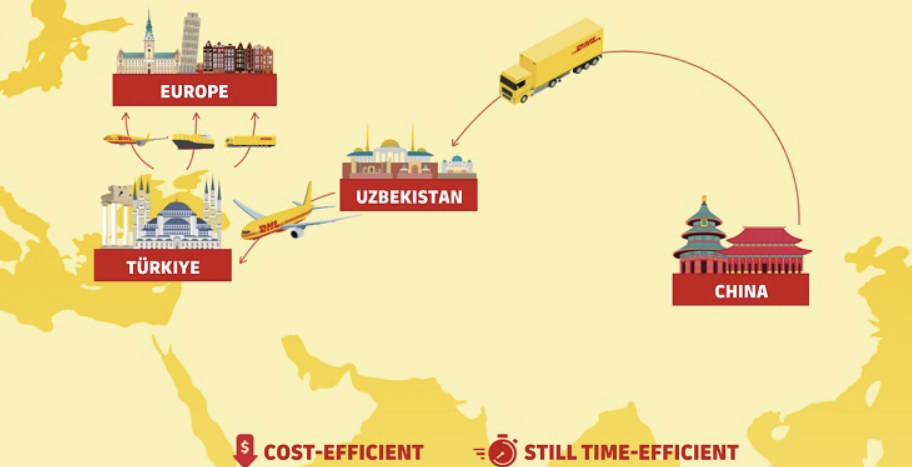
DHL Global Forwarding (DGF) recently launched a new multimodal service 'TRUCKAIR' for large-volume, heavy cargo between China and Europe.
TRUCKAIR operates by picking up cargo inland in China, transporting it by truck to Tashkent, Uzbekistan, then connecting via air freight to Istanbul, Turkey, and onward distribution across Europe.
The total lead time from China to Turkey is approximately 9–11 days, only 4–5 days longer than pure air freight (4–7 days).
As a customized solution, costs vary per shipment, but according to DHL, cases of six-figure (USD) cost savings over two months compared to pure air freight have been reported.
The strength of TRUCKAIR lies in targeting large-volume general cargo, achieving cost competitiveness compared to traditional air freight while maintaining delivery schedules suitable for time-sensitive, high-volume industries such as retail.
Meanwhile, Aditi Lathguinhar, CEO of DHL Global Forwarding Greater China, stated, “Driven by the expansion of China-Europe and Asia-Europe trade, demand for agile and cost-effective logistics solutions continues to grow.” She added, “According to recent market updates, tight supply and rising rates are expected ahead of the Chinese New Year, with a demand peak forecast in early February 2026.”
4) China's Low-Cost & E-commerce Exports Fall 9% in December; Europe-bound Shipments Plunge 24%
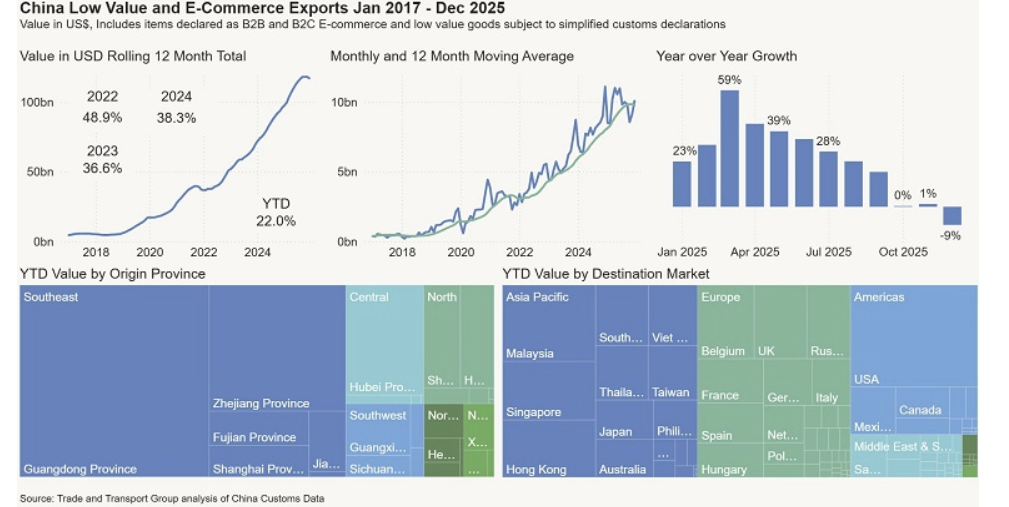
China's exports of low-value goods and e-commerce products decreased by 9% year-on-year in December last year.
In particular, exports to Europe, which had partially offset the slowdown in the U.S. market, plummeted by approximately 24%, indicating a clear adjustment phase in the overall flow of low-value, small shipments from China.
This analysis is based on Chinese customs data published on LinkedIn by Frederic Horst of the Trade and Transport Group. Following the termination of the U.S. de minimis exemption in May last year, low-value and e-commerce exports to the U.S. contracted rapidly, and the European market, which had filled that gap, also lost growth momentum toward the end of the year.
China's low-cost and e-commerce exports have maintained a steep long-term growth curve since 2017, with the 12-month rolling total exceeding $100 billion between 2024 and 2025.
While still growing on an annual basis, the slowdown in growth is pronounced. Annual growth rates were ▲48.9% in 2022 ▲36.6% in 2023 ▲38.3% in 2024, showing strong growth, but a gradual slowdown was observed in 2025. Regional data shows that the origin of low-cost and e-commerce exports remains concentrated in China's southeastern coastal areas such as Guangdong, Zhejiang, Fujian, and Shanghai.
This is a typical structure combining China's e-commerce manufacturing hubs with air and sea logistics infrastructure, and is expected to be difficult to change in the short term.
Experts are focusing on the potential structural impact of the slowdown in China's low-cost and e-commerce exports on the global air cargo market. As e-commerce cargo has simultaneously driven demand for both airline belly capacity and freighters on Americas and Europe routes, a slowdown in growth could lead to route-specific demand rebalancing and increased rate volatility.
5) Parata Air – to Launch Long-Haul Routes Including U.S. This Year

“Manufacturing and service industries are not very different in that they prioritize customer satisfaction above all else.” In an interview with the Korea Economic Daily at Parata Air's Seoul office in Magok-dong on the 22nd, CEO Yoon Chul-min stated, “I will apply the management know-how accumulated over 50 years in manufacturing to Parata Air.” Winix, founded in 1973, is a home appliance company known for air purifiers and dehumidifiers.
As the eldest son of Winix founder Chairman Yoon Hee-jong, CEO Yoon has become the only owner-CEO in the domestic low-cost carrier (LCC) industry.
When Winix acquired the court-managed Fly Gangwon in 2024, some expressed concerns that “the essence of manufacturing and service industries is fundamentally different.” However, Parata Air's progress has been rapid. Winix renamed the airline Parata Air, meaning “vivid blue,” reissued its Air Operator Certificate (AOC) in September last year, and launched domestic services in October and international services (Japan, Vietnam) in November, drawing attention in the LCC industry.
CEO Yoon said, “As Winix celebrated its 50th anniversary and explored new growth engines, we focused on the aviation industry.” He added, “While doing overseas business, I flew so often that I became a '2 million miler,' which naturally sparked my interest in aviation.” He personally established Winix's overseas branches in the U.S., Europe, and elsewhere to grow the company. CEO Yoon explained that the aviation industry's potential for business expansion into passenger and cargo transport, maintenance, repair, and overhaul (MRO), among other areas, was also a background for the Fly Gangwon acquisition. This is why Parata Air launched both passenger and cargo businesses simultaneously from its inception.
Parata Air is the only domestic LCC to operate business-class seats from launch. CEO Yoon emphasized, “The identity Parata Air pursues is neither a full-service carrier (FSC) nor an LCC,” but “combining the strengths of both categories to reasonably provide the services customers need.”
Parata Air is challenging itself to launch long-haul routes this year. “We are reviewing routes including the Americas,” CEO Yoon revealed, adding, “We will continue to expand our fleet, having confirmed the introduction of our 5th aircraft.” Parata Air already operates two medium-to-large aircraft, including the A330-200 (294 seats), laying the groundwork for long-haul routes.
Winix is actively supporting Parata Air by injecting KRW 115 billion through a capital increase. Based on this, the workforce has grown from 30 at the time of acquisition to around 400, with further hiring planned for this year.
CEO Yoon said, “After years in business, I have realized that what matters is not speed but sustainability.” He added, “Parata Air is also not sparing initial investment to take a long-term view.”
Share this article :


top