

The Power of Logistics to Move the World!
It's the Power of extrans.
EXTRANS GLOBAL - Air Freight News - Week 04 2026
Key Air Cargo Market Trends
1) Air Cargo Market on Alert as EU Tariff Dispute Re-ignites
Uncertainty in the air cargo market is rising again amid signs of a new tariff dispute between the United States and the European Union (EU).
U.S. President Donald Trump has stated his intention to impose a 10% tariff on eight European countries—Denmark, Norway, Sweden, France, Germany, the UK, the Netherlands, and Finland—starting February 1st. This represents a shift where diplomatic disputes over the Greenland purchase have transitioned into trade risks.
The EU is a core trading partner, accounting for approximately 20% of total U.S. imports. Notably, Germany, the UK, and France exported over $300 billion worth of goods to the U.S. by October of last year, centered on pharmaceuticals, medical devices, automobiles, and auto parts. Since these are high-value products with a high proportion of air cargo, analysts believe the tariff issue could directly impact air cargo volumes and rates.
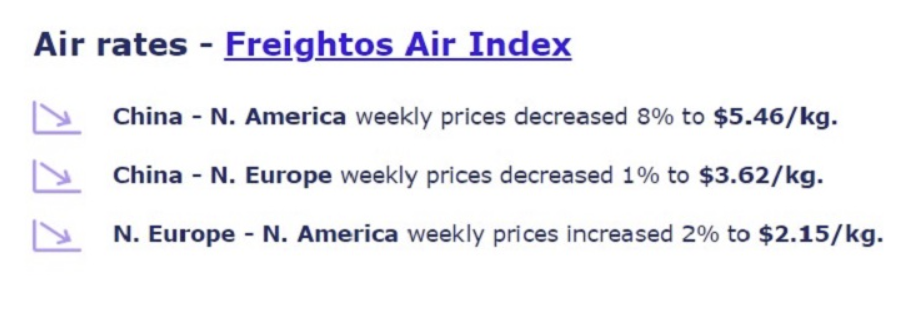
With time running out before the tariffs are imposed, making "frontloading" (advancing shipments) difficult in ocean transport, the air cargo market reacted first. Europe-North America air cargo rates rose by 2% following the tariff announcement, recording $2.21 per kg.
However, this upward trend is viewed as an extension of the gradual recovery flow that began in January from the $2.00 per kg level at the end of last year, and it is too early to call it a sharp supply-demand imbalance. Meanwhile, geopolitical risks in the Middle East also act as a structural burden for the air cargo market. As some airlines still avoid Iranian airspace, flight times on Asia-Europe routes are lengthening, leading to increases in fuel and operating costs.
The market is watching closely the possibility that if trade conflicts between the U.S. and EU intensify, volume shifts and rate volatility will expand, centered on items highly dependent on air cargo such as pharmaceuticals, medical devices, and auto parts.
2) Airlines Face 'Double Whammy' from Prolonged Closure of Iranian Airspace - Weak Off-Peak Rates + Detour Operation Costs

As European airlines continue to avoid Iranian airspace due to safety alerts, some flights on Asia-Europe routes are opting for detours.
This has led to increased flight times and operational cost burdens. Furthermore, with the air cargo market entering the off-peak season at the start of the year and rates showing weakness, airlines are suffering a double whammy.
Russian airlines have formalized operational adjustments. It has been reported that some European airlines, starting with Lufthansa Cargo and including British Airways, have adjusted or suspended routes in the region. Airlines Air India and IndiGo have also issued notices to passengers informing them of possible detours and delays during the closure of Iranian airspace.
The problem is that if avoiding Iranian airspace, Asia-Europe flights must choose either the northern route via Central Asia or the southern route around the Arabian Peninsula. These detour routes lead to increased block times and rising operating costs.
Supply on Asia-Europe routes is already steadily increasing, and coupled with this supply increase, spot market rates have turned weak as they entered the off-peak season. With no clear signs of a demand-led rebound, the operating cost burden on airlines remains a persistent and troublesome geopolitical risk.
3) LCCs That Missed Jakarta Traffic Rights Focus on Securing China Routes


The Incheon~Indonesia Jakarta traffic rights, which were fiercely competed for in the aviation industry, went to T'way Air.
The Low-Cost Carriers (LCCs) that missed out on the Jakarta traffic rights this time are making full efforts to secure China traffic rights scheduled for distribution this year.
Due to the merger of Korean Air and Asiana Airlines, the Fair Trade Commission (FTC) pointed out a total of 9 China routes as having monopoly concerns: △7 routes from Incheon to Beijing, Shanghai, Shenzhen, Xi'an, Zhangjiajie, Changsha, and Tianjin, and △2 routes from Busan to Beijing and Qingdao.
The redistribution of traffic rights and slots for these 9 China routes is proceeding separately from the regular 2026 traffic rights allocation by the Ministry of Land, Infrastructure and Transport.
As major core cities in China with tourism infrastructure, Shanghai and Beijing are expected to see fierce competition in the allocation of traffic rights.
Additionally, regions such as Zhangjiajie, Shenzhen, and Xi'an are also evaluated as areas attracting airlines' interest.
Xi'an is home to Samsung Electronics' NAND memory factory, Samsung SDI's EV battery production plant, and numerous partner companies, so commercial demand is expected to remain steady.
The aviation industry expects fierce competition to occupy these major China routes.
In particular, Jeju Air, Eastar Jet, and Air Premia, which missed the Jakarta traffic rights, are expected to show interest in China routes.
In the case of Air Premia, it is expected to have a positive effect as it can also target transfer demand between China and the Americas.
The Ministry of Land, Infrastructure and Transport has not yet decided on the timing for the allocation of China route traffic rights, but the process is expected to be completed as early as within the first half of the year.
4) Saudi Riyadh Air Launches 'Riyadh Cargo'
Saudi Arabia's emerging national airline, Riyadh Air, officially launched its cargo brand 'Riyadh Cargo', entering the global air cargo market.
Through this launch, Riyadh Air aims to make air cargo business utilizing the belly capacity of owned and ordered wide-body aircraft a core axis of commercial operations, and to nurture Riyadh as a global logistics hub representing the Middle East.
Riyadh Cargo has adopted a scalable cargo business model that grows step-by-step in line with the scale of aircraft operations to be expanded in the future, including the 122 latest wide-body aircraft currently on order. This is a method of growing cargo capacity alongside network expansion and operational maturity, aiming to build an integrated air logistics system with Riyadh as the central hub.
Meanwhile, Riyadh Air has set a goal to build a fleet of over 180 aircraft and more than 100 global routes by 2030, contributing about $20 billion to Saudi non-oil GDP and creating more than 200,000 direct and indirect jobs.
Share this article :


top