

The Power of Logistics to Move the World!
It's the Power of extrans.
EXTRANS GLOBAL - Air Freight News - Week 03 2026
Key Air Cargo Market Trends
1) Air Cargo Enters Post-Peak Adjustment Phase, with Demand for AI & Electronics Providing Downside Support
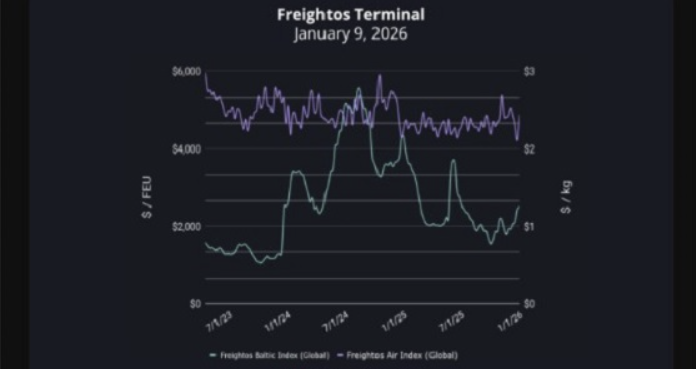
At the start of the year, despite high ocean freight rates and geopolitical/trade policy variables, the global logistics market shows the air cargo sector clearly entering a "correction phase."
However, industry analysis suggests this adjustment is not merely a contraction in demand, but rather a normalization process following the year-end peak season.
Freightos noted that air cargo rates have continued to decline overall since peaking in December. According to the Freightos Air Index (FAI), rates on China-US routes fell below $6/kg, hitting their lowest level since October last year. Additionally, Southeast Asia-US rates dropped below $4/kg, indicating that peak season premiums are being resolved rapidly.
This is interpreted as the normalization of temporary capacity that airlines had deployed for the peak season, coinciding with the end of year-end e-commerce specials.
Although cold waves and heavy snow in Europe caused flight cancellations and delays, most operations returned to normal this week, limiting the overall impact.
Furthermore, trans-Pacific air cargo volumes, which had plummeted after the suspension of the US de minimis shipping rules, have shown a gradual recovery recently. Notably, this rebound is being driven by an increase in general cargo rather than a partial recovery in e-commerce volumes.
Meanwhile, instability in the Middle East, risks in the Strait of Hormuz, and US-China tariff policies are having a greater impact on ocean freight rates and vessel operations in the short term. However, should disruptions occur in ocean networks, the possibility of some high-value cargo switching to air freight remains open.
In summary, while the air cargo market entered a natural adjustment phase in early 2026 following the year-end peak, the pattern differs from past sharp demand vacuums. While reliance on e-commerce decreases, structural demand centered on the AI, semiconductor, and electronics industries is providing downside support.
2) December Strength Maintained, but Signals Point to "Gradual Adjustment" in Early 2026 (by BAI)
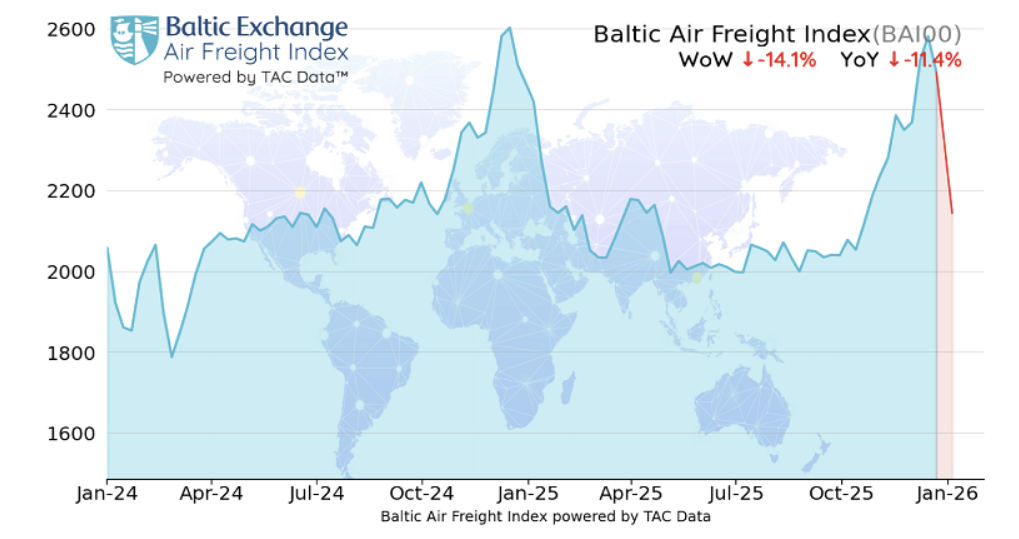
According to the Baltic Air Freight Index (BAI), the December BAI Composite Index (BAI00) rose 7.74% month-on-month, reaffirming year-end strength. However, with rates from China and Hong Kong adjusting rapidly in early January, there is a possibility that the market environment will soften further in early 2026.
<Four Key Factors Moving the December Market>
- Peak season demand strongly supported Asia-origin volumes: Increased e-commerce shipments, accelerated factory operations ahead of the Lunar New Year, and space shortages for semiconductor/high-tech cargo combined to drive strength on long-haul routes from Shanghai and Hong Kong.
- Supply chain restructuring and high-tech cargo underpinned long-haul routes: Demand to Europe was maintained as production bases dispersed to Southeast and Northeast Asia. Furthermore, increased semiconductor volumes from Taiwan and Korea intensified supply tightness ahead of the Lunar New Year.
- Selective freighter redeployment boosted Transatlantic performance: The rebound on Frankfurt-Americas routes and in Chicago is analyzed as a result of airlines moving capacity to routes with high profitability and loading stability even during winter.
- Post-peak normalization trend detected from mid-December: As inventory replenishment concluded and a wait-and-see attitude toward shipments ahead of the Lunar New Year began, the market entered a seasonal adjustment.
<Early 2026 Outlook: Moderate Growth, but Expanding Uncertainty>
CFC forecasts that December's strength will shift to a typical post-peak adjustment in January. While load factors remained stable thanks to high-value cargo from Asia and limited supply increases, rate momentum is weakening on major routes.
Although e-commerce is still growing, the growth rate is expected to slow further. Overlapping policy uncertainty and slowing e-commerce growth mean that 2026 air cargo demand growth is likely to remain in the low single digits.
The gap between high-tech cargo and general consumer goods is also expected to widen. In Q1, demand slowdown is expected to restore some bargaining power to shippers, putting downward pressure on rates. However, the possibility of a short-term rebound in early February remains due to concentrated shipments from China, Korea, and Taiwan before the Lunar New Year.
3) Airzeta - Unveils First Aircraft with New CI
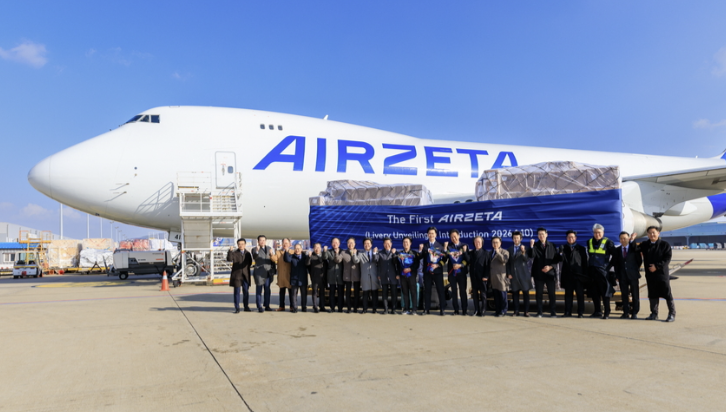
Specialized cargo airline Airzeta unveiled its first aircraft featuring a new Brand Identity (CI). Airzeta held a welcome ceremony for the introduction of the first new livery aircraft at the apron of Incheon International Airport Cargo Terminal on the afternoon of the 10th. The event was attended by CEO Kwan-sik Kim and employees.
Airzeta explained that the arrival of this first aircraft signals the completion of visual integration, following system and organizational integration since the official launch of Airzeta on August 1st last year through the merger of Air Incheon and Asiana Airlines Cargo Division.
Airzeta plans to sequentially repaint its entire fleet starting with this first aircraft to strengthen brand unity.
Furthermore, the company aims to fully realize synergies by combining the mid-to-short-haul operational know-how of the former Air Incheon with the long-haul network and large aircraft operational capabilities of Asiana Cargo. With the introduction of this first aircraft, Airzeta will accelerate its strategy for long-haul cargo routes such as the Americas and Europe, and focus on expanding market share in the transportation of high-value cargo such as semiconductors and bio-pharmaceuticals.
4) CargoAi - Achieves First-Ever 'Cash Flow Positive Quarter'
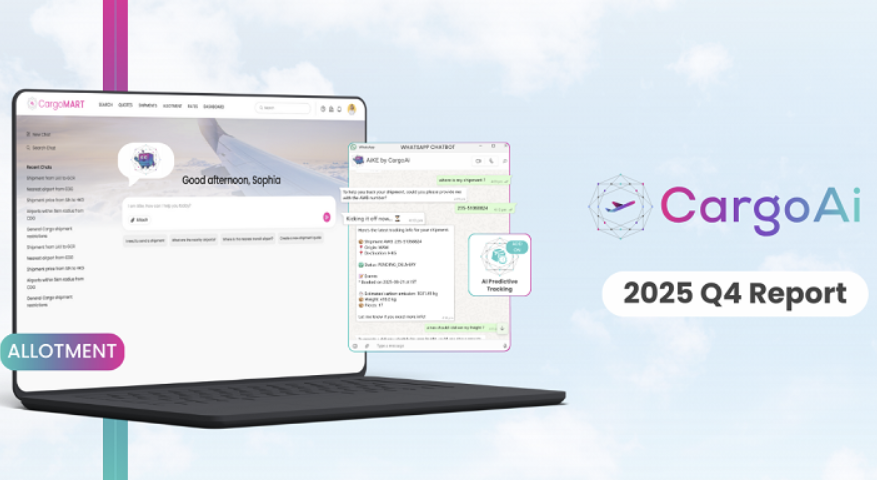
CargoAi announced its Q4 2025 results, solidifying its position as the strongest and fastest-growing company among global air cargo digital platforms.
This quarter marked the company's best performance since its founding, with the achievement of being cash flow positive on a quarterly basis as the key result.
CargoAi saw a 60% year-on-year increase in eBooking transaction volume in Q4 2025. It is currently linked with 104 airlines, and 30 new global forwarders have joined as enterprise customers.
Additionally, CargoAi is outperforming traditional solutions and digital competitors in the Air Cargo Rate Management sector, as evidenced by a 98% customer retention rate. Key features were launched across the platform in Q4 2025. Matt Petot, CEO of CargoAi, stated, "This result is the outcome of strict financial discipline and obsessive focus on customer-centric innovation," adding, "As the most agile and AI-centric platform in the air cargo ecosystem, we will accelerate innovation to exceed market expectations in 2026."
Based on a stable financial structure and expanding global adoption, CargoAi announced plans for large-scale investment in 2026.
5) Airlines Movement
- Cathay Pacific (CX): Increases frequency on the Incheon-Hong Kong route to 5 flights per week starting from the Summer Schedule on March 29th.
- Silk Way West Airlines (7L): Increases frequency on the Houston-Baku cargo route to twice a week starting January 10th, aiming to transport local energy and industrial cargo demand.
Share this article :


top