

The Power of Logistics to Move the World!
It's the Power of extrans.
What Is Bonded Warehousing? The "Duty-Free Time Machine" for Global Importers
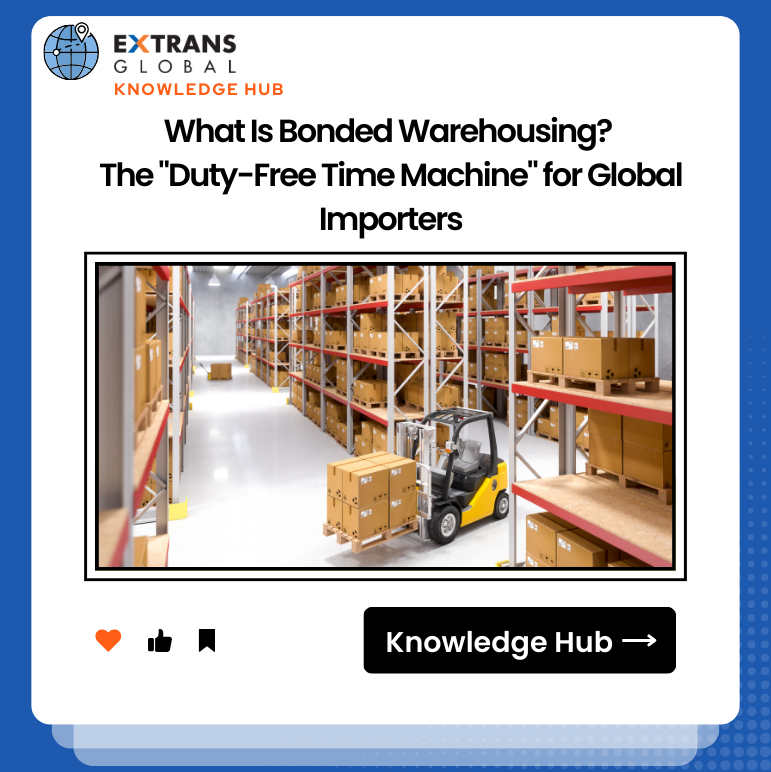
Imagine you import high-end Italian furniture into the United States. The shipment arrives at the Port of New York. The total value is $500,000, and the import duty is 10%—which means you owe **$50,000** in taxes immediately.
But there is a problem: You don't have a buyer for the furniture yet. You don't want to pay $50,000 in cash today for goods that might sit in your warehouse for six months.
What if you could hit a "pause button" on your tax bill?
That is exactly what a Bonded Warehouse does. It is a secure storage facility authorized by the government where imported goods can be stored, manipulated, or manufactured without paying customs duties until the goods are removed for domestic consumption.
It is essentially a "Tax-Free Storage Locker" run by the government. Let’s break down how it works, why it is a financial superpower for importers, and the "Catch-22" that makes it risky.
First: How Does a Bonded Warehouse Work?
Normally, when goods arrive in a country, you have two choices:
- Pay the duty and take them home.
- Send them back (Export).
A Bonded Warehouse gives you a Third Option:
3. Store them in the Bonded Warehouse.
Here is the timeline:
- Arrival: Your furniture arrives at the port.
- Admission: Instead of paying the duty, you (or your customs broker) post a "Bond" (an insurance policy guaranteeing that if the goods disappear, you will pay the government the taxes).
- Storage: The goods are moved into the Bonded Warehouse.
- The Pause: You pay $0 in duties. You only pay the storage fee to the warehouse operator.
- The Trigger: You pay the duty only when you physically take the goods out of the warehouse to sell them to a customer in the U.S.
- If you sell them to a customer in Canada while they are still in the warehouse? You pay $0 (because they are considered exported, not imported).
The "Secret Weapon": In-Warehouse Manipulation
Bonded Warehouses aren't just for sitting still. You can actually modify the goods inside to lower your tax bill. This is called In-Bond Manipulation.
- The Scenario: You import "Frozen Lobster Tails" (High Duty: 15%).
- The Problem: You want to sell "Cooked and Chilled Lobster Meat" (Lower Duty: 5%).
- The Solution: You send the raw tails into a Bonded Warehouse. Inside, a processing plant cooks them, removes the shells, and packages the meat.
- The Result: When you take the meat out, you pay the 5% duty on the finished product, not the 15% on the raw material. You just saved 10% on taxes legally.
Other common manipulations include:
- Labeling (adding "Made in China" stickers).
- Repackaging (breaking down pallets into retail boxes).
- Grading (sorting good apples from bad apples).
The Three Types of Bonded Warehouses
- Public Bonded Warehouse: A facility open to any importer. It is like a public storage unit but with government surveillance.
- Private Bonded Warehouse: A facility owned and operated by a specific company for their own use (e.g., Amazon or Walmart might have their own).
- Type 8 / Distribution Center: A modern facility designed for high-volume distribution where goods can be stored for up to 5 years (in the U.S.).
The Financial Superpowers (Why Use It?)
- Cash Flow Optimization: This is the biggest benefit. You don't tie up working capital in taxes until you actually make a sale.
- Contingency Flexibility: If the market crashes and no one wants your furniture in the U.S., you can export it to Europe directly from the warehouse and pay $0 in U.S. duties.
- Quality Control: You can inspect the goods inside the warehouse. If you find they are defective, you can destroy them (under government supervision) and pay $0 in duties.
The "Catch-22": The Bond
The name "Bonded" comes from the financial guarantee you must post.
- The Risk: If the goods are stolen, damaged, or "accidentally" leave the warehouse without paying duty, the government comes after you for the full tax amount.
- The Consequence: If you go bankrupt and abandon the goods in the warehouse, the government will sell them at auction to recover the duties. If the auction doesn't cover the tax bill, your bond covers the rest.
The Last Word: Control Your Cash
In global trade, timing is everything. Bonded Warehousing gives importers the rare luxury of controlling when they pay their taxes.
It turns a mandatory immediate expense into an optional deferred expense. For high-value, slow-moving, or market-sensitive goods, it is not just a warehouse—it is a strategic financial tool.
Share this article :


top