

The Power of Logistics to Move the World!
It's the Power of extrans.
What Is Roll-On/Roll-Off (Ro-Ro) Shipping? The "Drive-On, Drive-Off" Solution for Wheels and Heavy Equipment
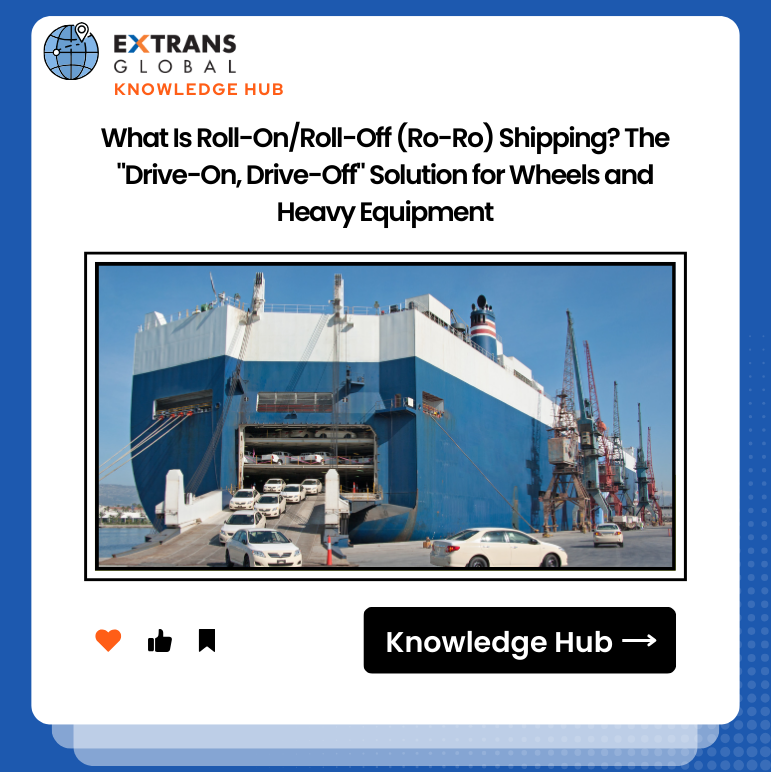
When you need to ship a brand-new car from Japan to the U.S., a fleet of buses from Europe to Africa, or a massive mining truck to Australia, you don’t lift them into a container with a crane. You drive them onto a specialized ship. This method is called Roll-On/Roll-Off (Ro-Ro) shipping.
Ro-Ro is the logistics industry’s version of a "floating parking garage" or a "seagoing semi-trailer." It relies on vehicles (or equipment on wheels) driving onto the ship at the origin port and driving off at the destination. For the automotive, construction, and agriculture industries, Ro-Ro is the standard—fast, efficient, and designed specifically for cargo that moves under its own power (or is rolled on using a platform).
Let’s break down what Ro-Ro shipping is, how it works, the specialized ships involved, and why it’s the king of moving vehicles globally.
First: What Exactly Is Ro-Ro Shipping?
Roll-On/Roll-Off (Ro-Ro) is a maritime shipping method designed for wheeled cargo. The name comes from the process: cargo is driven, or rolled, onto the vessel at the port of departure and driven, or rolled, off at the port of arrival.
Unlike Lift-On/Lift-Off (Lo-Lo) shipping (where containers are lifted on and off with cranes), Ro-Ro vessels have built-in ramps and multiple internal decks. This allows for a continuous flow of traffic, similar to a multi-story parking lot.
Common Ro-Ro Cargo Includes:
- Automobiles: Cars, trucks, SUVs, vans.
- Heavy Machinery: Excavators, bulldozers, tractors, mining trucks.
- Buses & Trains: City buses, coaches, and even light rail systems.
- Trailers & Containers: Sometimes, standard shipping containers are loaded onto chassis (trailers) and driven on as "wheelized cargo" (though this is less common than using dedicated container ships).
The "Floating Skyscraper": Inside a Ro-Ro Vessel
A Ro-Ro ship looks like a massive cargo vessel from the outside, but the inside is a marvel of vertical engineering:
- The Ramp: The most iconic feature. A massive, hydraulically operated ramp drops down from the stern (back) or bow (front) of the ship to the dock. These ramps can handle weights of up to 500 tons, allowing the heaviest mining trucks to drive aboard.
- Internal Decks: Instead of open holds, the ship has multiple horizontal decks (sometimes 10 or more).
- Hoistable Decks: To maximize space, many decks can be raised or lowered like an elevator. This allows the ship to carry tall cargo (like a semi-truck) on the lower level and stack cars on the upper level.
- Internal Ramps: Just like a parking garage, the ship has ramps connecting the decks, allowing vehicles to drive up to the 10th floor without leaving the ship.
How Ro-Ro Shipping Works (Step-by-Step: A Luxury Car)
Let’s follow a luxury sedan built in Germany as it travels to a dealership in the U.S.:
Step 1: Factory to Terminal
The car is driven from the German factory to a nearby Ro-Ro terminal. It is inspected, and a metal tag is attached to the side window with a unique ID number (the Vehicle Identification Number, or VIN).
Step 2: The "Stowage Plan"
Before loading, a ship planner creates a stowage plan. This is a digital map of exactly where every car goes.
- Heavy vehicles (like trucks) go on the bottom decks (for stability).
- Tall vehicles go on decks with high clearance.
- Luxury cars are often placed in secure, interior decks away from saltwater spray.
Step 3: Driving Aboard (The "Ro-Ro")
A professional driver (called a mearshant navy driver or a local terminal driver) drives the car up the ship’s massive ramp. They follow the stowage plan, driving up the internal ramps to the assigned deck.
Step 4: Securing the Cargo ("Lashing")
Once parked, the car is turned off. A team of stevedores (dockworkers) immediately lash the car down. They use heavy-duty straps and chains to secure the wheels to recessed points in the ship’s floor.
- Why? Even if the ship rocks in a storm, the car cannot move an inch.
Step 5: The Voyage
The ship sails across the ocean. Unlike containers, the cargo is not exposed to the elements (if it’s on an internal deck), which is great for protecting the car’s paint and electronics.
Step 6: Driving Off
The ship arrives in New York. The ramps are lowered. The lashings are removed. A driver starts the car and drives it down the ramp and onto the dock.
Step 7: Final Delivery
The car is loaded onto a truck (or driven) to the dealership, where it is cleaned and prepared for sale.
Ro-Ro vs. Container Shipping (Lo-Lo): Which Is Better?
If you are shipping a car or machine, you have two main choices. Here is how they compare:
| Feature | Ro-Ro (Roll-On/Roll-Off) | Container (Lo-Lo - Lift-On/Lift-Off) |
| Loading Method | Driven on by a driver. | Lifted in by a crane. |
| Cost | Cheaper for standard vehicles (no need for a container chassis). | More expensive (you pay for the container + chassis + crane lift). |
| Speed | Very Fast. You can load thousands of cars in a few hours. | Slower. Cranes can only lift one container at a time. |
| Protection | Good. Protected from the sea, but exposed to dust and dirt during driving. | Best. The container is sealed, offering maximum security and protection from the elements. |
| Suitability | Best for cars, trucks, buses, and tracked equipment. | Best for high-value classic cars (needs protection) or non-wheeled cargo. |
| Accessibility | Requires ports with Ro-Ro infrastructure (ramps). | Can go to almost any port in the world. |
The Special Case: ConRo Ships
There is a hybrid ship called a ConRo (Container/Roll-on-Roll-off) vessel. It is split into two parts:
- The Top: Carries standard shipping containers stacked on deck.
- The Bottom: Has a garage for vehicles and heavy equipment.
- Why use it? It allows shipping lines to maximize space on a single voyage, carrying both consumer goods (containers) and cars.
Why Ro-Ro Is Critical for Global Trade
Ro-Ro shipping is the invisible highway for the world’s industrial and consumer vehicles.
- Automotive Industry: 90% of the world’s new cars are shipped via Ro-Ro.
- Disaster Relief: When a country needs generators, ambulances, or construction equipment after an earthquake, Ro-Ro ships can deliver them ready-to-use in days.
- Project Cargo: As we discussed in the previous topic, Ro-Ro is often the easiest way to move giant mining trucks or farm tractors to remote ports.
The Last Word: Efficiency on Wheels
Ro-Ro shipping proves that sometimes, the simplest solutions are the best. Instead of inventing complex ways to lift heavy things, the industry simply asked: "Can we drive it there?"
By turning ships into floating highways, Ro-Ro logistics keeps the global economy moving—quite literally—on all four wheels.
Share this article :


top