

The Power of Logistics to Move the World!
It's the Power of extrans.
EXTRANS GLOBAL - Air Freight News - Week 18 2026
1. Major Trends in Air Cargo Market
1) LCCs Significantly Expand ‘Profitable’ Routes to China
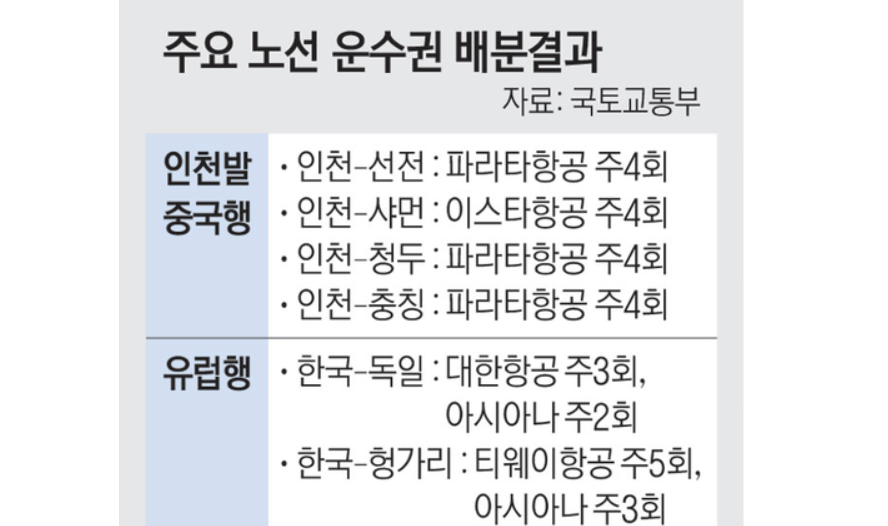
- Low-cost carriers (LCCs) are leading a major expansion of “profitable” routes to China. Direct flights from regional airports to China are increasing significantly, and existing major routes are also seeing added frequencies, signaling the full-scale intensification of competition among airlines.
- On the 23rd, the Ministry of Land, Infrastructure and Transport held an Air Transport Deliberation Committee meeting and allocated traffic rights for 35 international routes to 11 Korean airlines.
- Passenger demand between Korea and China has recovered to pre-COVID levels, with 4.39 million passengers recorded in the first quarter, leading to increased international routes between the two countries.
- A notable feature is the active allocation of traffic rights to LCCs, moving away from the previous FSC (Full-Service Carrier)-centric structure. Among major Incheon–China routes, Chongqing, Shenzhen, and Chengdu will each see 4 additional weekly frequencies, operated by Parata Airlines. The Incheon–Xiamen route (4 weekly) was allocated to Eastar Jet.
- New routes are also expanding. Ningbo, where many Korean companies have entered the market, will be operated by Asiana Airlines and Air Premia (3 weekly each). Wuxi route (3 weekly) was allocated to Korean Air. Yichang (3 weekly) and Hohhot (2 weekly) were allocated to Jin Air and Eastar Jet respectively.
- The Daegu–Shanghai route (7 weekly) was split between Eastar Jet (4 weekly) and Jeju Air (3 weekly). The suspended Yangyang international routes will resume, with Parata Airlines operating 3 weekly flights to Shanghai.
- Meanwhile, long-haul routes to Eastern Europe are also expanding. The Hungary route was allocated to T’way Air (5 weekly) and Asiana Airlines (3 weekly), while the Austria route was allocated to Korean Air (3 weekly).
2) Prolonged Middle East Crisis Delivers ‘Direct Hit’ to Air Cargo Market — “Upward Momentum Broken as of April”
-
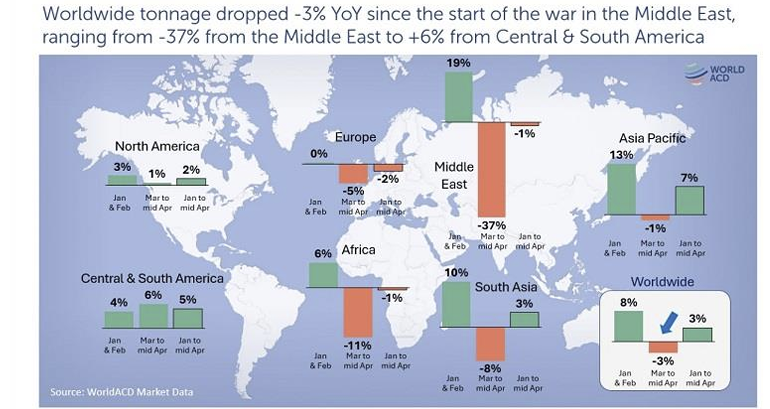
Global air cargo market reaches a turning point: Sharp slowdown following the Middle East crisis.
-
Geopolitical tensions in the Middle East have directly impacted the global air cargo market. The solid recovery trend seen at the beginning of the year has clearly shifted to a downward trend starting in March.
-
Not only the Middle East, but also major routes in Asia-Pacific and Africa have seen accompanying declines, rapidly increasing uncertainty across global supply chains.
-
Middle East Region: From biggest beneficiary to biggest victim — dramatic reversal.
- Cargo volume from the Middle East grew +19% year-on-year in Jan–Feb, benefiting greatly from disruptions in sea transport due to the Red Sea crisis.
- From March onward, intensified conflict and airspace restrictions caused operational disruptions. Cargo volume from March to mid-April plummeted -37%, an extreme reversal.
- The region showed the highest volatility globally, shifting from double-digit growth to double-digit decline.
-
Asia-Pacific: Entering a slowdown phase after leading growth.
- Asia-Pacific led global cargo growth with +13% in Jan–Feb, but turned to -1% decline after March.
- China-origin cargo (-7%) was a major factor in the decline, though cumulative growth remains +7%.
-
Key Implications
- The -37% plunge in Middle East cargo is the main driver of the global decline (-3%).
- Increased regional polarization: Americas and Latin America growing, while Middle East and Africa sharply declining.
- After the conflict, the global air cargo market has shifted to “regionally differentiated flows.”
3) T’way Air Launches New Incheon–Jakarta Service on April 29
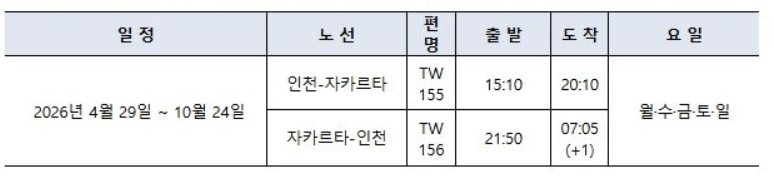
- The Incheon–Jakarta route will operate 5 times weekly (Mon, Wed, Fri, Sat, Sun). The outbound flight departs Incheon at 15:10 and arrives at Jakarta Soekarno-Hatta Airport at 20:10 local time.
- The return flight departs Jakarta at 21:50 and arrives in Incheon at 07:05 the next day.
- The airline will deploy its large wide-body aircraft, the A330-300, to maximize passenger comfort. The aircraft has 347 seats: 12 Business Saver class and 335 Economy class.
- This route was reallocated by the Ministry of Land, Infrastructure and Transport to a non-Korean Air subsidiary to resolve monopoly concerns arising from the merger of Korean Air and Asiana Airlines.
- T’way Air completed preparations, including opening a local office, based on traffic rights secured through a route competition review in January, and has now commenced operations.
- Jakarta, the capital of Indonesia, is a leading Southeast Asian hub city with shopping, cuisine, and cultural heritage. Business demand is high due to local factories operated by Korean companies such as Hyundai Motor, POSCO, and LG Energy Solution. It also offers excellent access to nearby tourist destinations such as Bali.
4) Efforts to Resolve Korean Air Monopoly Have Only Increased LCC Losses
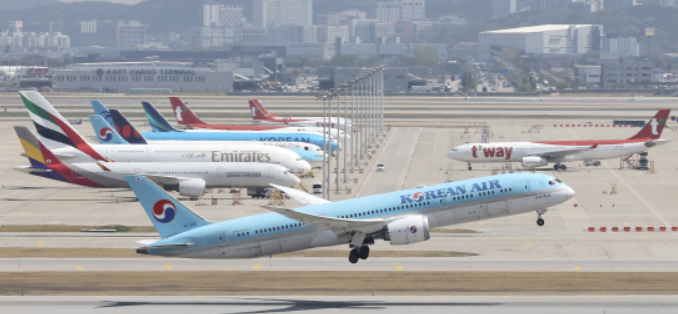
- Critics argue that traffic rights allocation aimed at preventing monopoly during the Korean Air–Asiana merger has instead worsened the financial distress of low-cost carriers (LCCs).
- For LCCs, which need to offset stagnant profitability on long-haul Europe and Americas routes, this year’s allocation of “golden” China routes is expected to be a crucial turning point for improving profitability.
- On the 22nd, the Ministry of Land, Infrastructure and Transport held an briefing for the latest regular traffic rights allocation, including 9 China routes.
- This allocation is part of corrective measures related to the Korean Air–Asiana merger. Normally, regular traffic rights allocations occur 1–2 times per year, but the large inclusion of China routes this time has drawn significant industry attention.
- Target routes include Incheon–Beijing, Shanghai, Shenzhen, Xi’an, Zhangjiajie, Changsha, Tianjin, and Busan–Beijing, Qingdao (total 9 routes). Notably, the Incheon–Guangzhou route is currently served only by Korean Air, Asiana, and China Southern Airlines.
- Within the industry, there is growing caution that this allocation should not repeat the mistakes of previous Europe and Americas route transfers.
- In the past, T’way Air and Air Premia were selected as alternative competitors in merger remedies, but long-haul routes have instead exposed the structural limitations of LCCs. Operating long-haul routes without sufficient preparation (large aircraft introduction and local operations) has become a major management burden.
- T’way Air rapidly launched four European routes (Rome, Paris, Barcelona, Frankfurt) and Vancouver, Canada, causing fixed costs (A330 aircraft, local offices, maintenance, labor) to surge exponentially.
- In the previous year, T’way Air recorded revenue of KRW 1.7982 trillion but an operating loss of KRW 265.5 billion — more than 20 times higher than the previous year’s KRW 12.3 billion loss. The company cited exchange rates, rising fuel prices, and increased costs from expanding medium- and long-haul routes.
- As a result, airlines are more likely to deploy large aircraft on profitable Japan routes instead of Europe/Americas.
- An industry source warned of the worst-case scenario: “excessive supply on short- and medium-haul routes leading to cutthroat competition.” They added that intensified oversupply competition on Japan and China routes could further deteriorate profitability, ultimately lowering service quality and variety for consumers.
Share this article :


top