

The Power of Logistics to Move the World!
It's the Power of extrans.
EXTRANS GLOBAL - Air Freight News - Week 12 2026
Air Cargo Market Highlights
1) T'way Air Enters Emergency Management Amid Middle East War Fallout
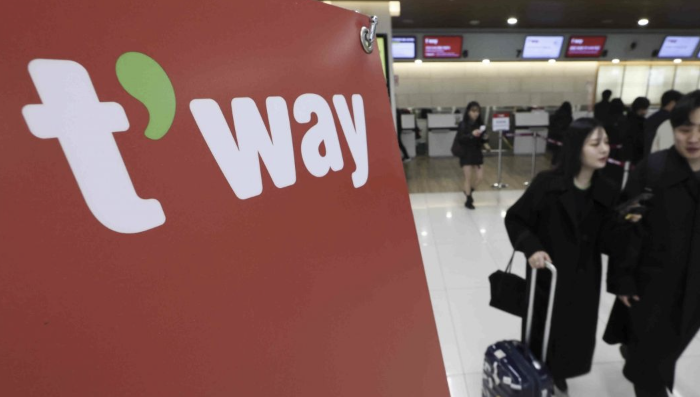
South Korea’s second-largest low-cost carrier (LCC), T'way Air, has launched an emergency management system, marking the first such move by a Korean airline since the U.S.-Iran conflict erupted. The decision stems from plummeting profitability driven by soaring global oil prices, rising KRW-USD exchange rates, and weak travel demand, with forecasts warning other carriers may follow suit sequentially.
In an internal notice posted on the 16th, T'way Air announced company-wide emergency management, stating that rapidly shifting external conditions—including heightened geopolitical uncertainty and volatile exchange/oil prices—require proactive risk mitigation to secure financial stability.
Immediate measures include a full review of investment plans and cost structures, delaying or adjusting non-essential spending and projects. Employees are ordered to cut all non-mandatory expenses, while the airline will continuously monitor key operational metrics and roll out phased additional countermeasures if needed.
The trigger for the emergency mode is the oil price surge from the Middle East crisis: Singapore jet fuel average (MOPS), the benchmark for April fuel surcharges (Feb 16–Mar 15), hit 326.71 cents/gallon ($137.22/barrel), a nearly 60% month-on-month jump. Industry insiders predict more LCCs will adopt emergency management, noting current losses deepen with every flight operated, and most carriers are reviewing contingency plans.
2) Limited Sea Freight Impact, Air Rates Surge Up to 50%
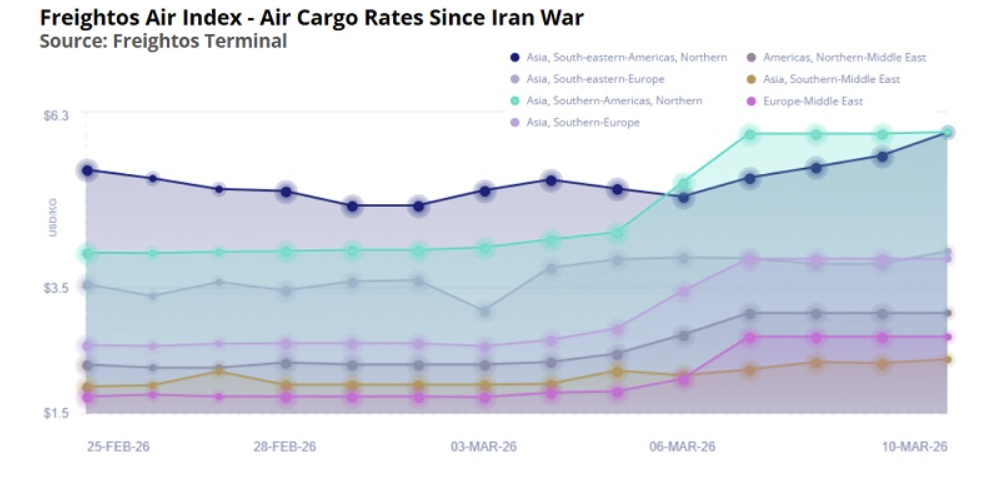
The effective blockade of the Strait of Hormuz since the Iran conflict has escalated tensions in global energy and logistics markets. While container shipping remains minimally affected, air cargo rates have jumped up to 50% on select routes due to closed Gulf airspace.
Nearly 10 days into the conflict, vessel transits through the Strait of Hormuz have plummeted. As a critical global crude oil shipping lane, restricted tanker movements have already triggered supply concerns and upward oil price pressure.
Air cargo faces far more direct disruption from closed Middle Eastern airspace. Major Gulf carriers supply ~13% of global belly cargo capacity and serve as core hubs for east-west air networks. Per the Freightos Air Index, rates have spiked sharply post-conflict:
- South Asia → North America: ~50% increase, $6/kg
- South Asia → Europe: ~$4/kg
- Southeast Asia → Europe: ~20% increase, over $4/kg
- China → U.S.: ~20% increase, over $7/kg
China-origin rate hikes reflect post-Spring Festival demand growth plus fierce competition for long-haul freighter space amid rerouted Gulf transit cargo. Recent partial recoveries have emerged: the UAE opened a safe air corridor handling 48 flights/hour, with Emirates restoring ~50% of normal operations. Some forwarders now reroute Gulf-bound cargo via alternative Saudi airports then connect overland transport.
3) Oil Price Explosion – All Carriers Rush to Hike Fuel Surcharges

Soaring oil prices from heightened Middle East tensions have severely hit sea and air logistics, rapidly expanding cost burdens for global shipping lines and airlines, with fuel surcharge hikes widely deemed inevitable across the industry.
Additional surcharges are spreading across all transport modes. Major global lines including Maersk now impose emergency conflict surcharges (ECS), emergency bunker surcharges (EBS), and war risk surcharges (WRS), ranging from $150 to $2,000 per lane. With ~20% of global fuel cargo transiting the Strait of Hormuz, current conditions have created an unprecedented high-cost environment for sea, inland, and intermodal transport.
Air cargo has immediately reflected oil price hikes: Oman Air Cargo announced simultaneous fuel and war risk surcharges across its network starting March 18. In Hong Kong, major airlines quadrupled fuel surcharges, triggering fierce pushback from forwarders.
For Korean carriers, current surcharges (Mar 16–Apr 15) are KRW 510 (long-haul), KRW 470 (mid-haul), KRW 450 (short-haul). Forecasts peg April surcharges (Apr 16–May 15) to jump ~3.5x to KRW 1,790 (long-haul), KRW 1,680 (mid-haul), KRW 1,600 (short-haul).
A key challenge: Middle East tensions have drastically cut Asia-Europe capacity, yet weak demand coincides with skyrocketing rates and surcharges. Southeast Asian manufacturing hubs see mild Europe-bound air demand, but limited capacity restricted to full freighters has driven irrational local rate hikes.
4) Parata Air Launches New Sapporo, Japan Route
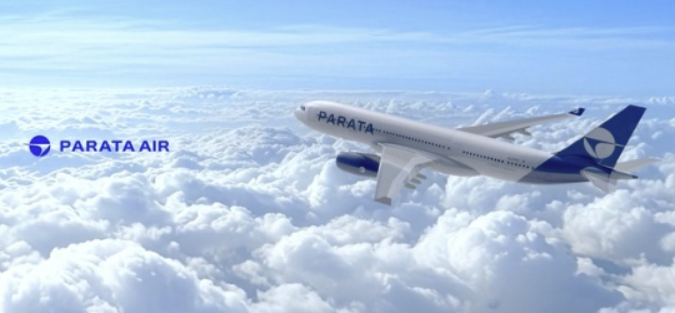
Parata Air announced on the 16th a new regular route between Incheon and Sapporo (New Chitose), launching July 6 with daily flights operated by Airbus A330 aircraft.
Flight Schedule: Depart Incheon International Airport at 11:10, arrive Sapporo New Chitose at 13:45 local time. Return flight departs Sapporo at 15:05, arrive Incheon at 18:10. The A330-200 aircraft, introduced in October last year, features 260 seats: 18 Business Smart Class and 242 Comfort Class seats.
Sapporo is a popular summer escape with mild average temperatures. Peak tourism runs July–August during lavender season and Hokkaido nature tours. The new route adds a key air option for summer Hokkaido travel demand.
5) Airlines Movement Updates
- Parata Air (WE): Announces daily regular Hanoi-Incheon flights starting July 13, operated by A330 aircraft.
- Air Jetta (KJ): Plans to lease 1 Boeing 747F freighter starting April 20 for North American routes (1-year lease term).
Share this article :


top