

The Power of Logistics to Move the World!
It's the Power of extrans.
Arrival Notice vs. Delivery Order: Two Documents to Know Before Collecting Import Cargo
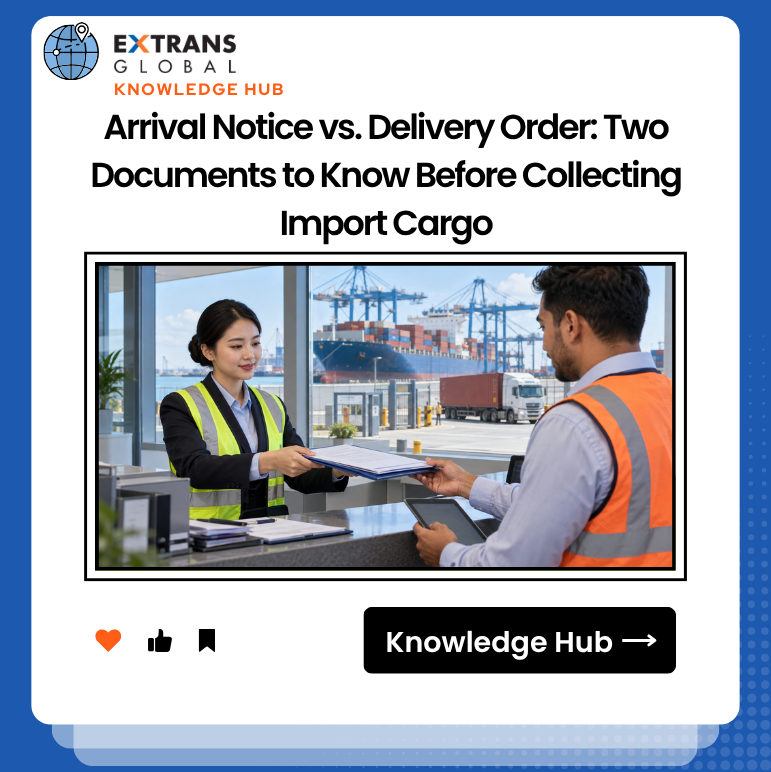
When import cargo approaches its destination, the consignee will usually receive an Arrival Notice and later obtain a Delivery Order. Both documents relate to cargo collection, but they serve different purposes.
The Arrival Notice helps the consignee prepare, while the Delivery Order authorizes the release of the cargo. Confusing the two may lead to customs delays, unsuccessful collection or additional charges.
What Is an Arrival Notice?
An Arrival Notice is normally issued by the carrier or destination agent to the consignee or notify party before the cargo arrives.
It generally includes:
- Vessel name and voyage number
- Bill of lading and container numbers
- Estimated arrival date
- Port of discharge and cargo details
- Destination charges or payment instructions
- Contact details of the destination agent
The consignee can use this information to arrange import customs clearance, settle charges, book a truck and plan final delivery.
However, an Arrival Notice only provides shipment information. It does not authorize the terminal to release the cargo.
What Is a Delivery Order?
A Delivery Order, commonly called a D/O, is a cargo-release document issued by the carrier or its destination agent.
The consignee normally needs to complete the bill of lading release process, pay the required charges and submit the necessary documents before receiving the D/O. The terminal, depot or warehouse then uses the valid D/O to release the cargo.
Depending on the country and port, the D/O may be issued on paper or as an electronic Delivery Order (eDO). Local carrier and port procedures should always be confirmed.
What Is the Difference?
- Arrival Notice: informs the consignee that the cargo is approaching or has reached the destination
- Delivery Order: authorizes the terminal or warehouse to release the cargo
- Arrival Notice: helps prepare customs clearance, payment and delivery
- Delivery Order: is used during the actual cargo-release process
- Arrival Notice: is normally issued before the estimated arrival
- Delivery Order: is issued after the applicable release requirements are completed
Simply receiving an Arrival Notice does not mean the cargo is ready for collection. A valid D/O is normally required before terminal pickup can proceed.
Key Points to Check
- Verify the consignee, bill of lading number, container number and ETA
- Confirm whether the cargo will be released against an original B/L, telex release or sea waybill
- Prepare customs documents and settle applicable charges early
- Apply for the D/O promptly to avoid unnecessary terminal storage
- Reconfirm the ETA, free time and pickup plan after schedule changes
- Check the empty-container return location and deadline
How EXTRANS GLOBAL Can Help
EXTRANS GLOBAL provides ocean freight, air freight, cross-border transportation, warehousing and cargo-handling services.
Our team can help monitor arrival information, prepare import documents, coordinate cargo release and arrange onward transportation for smooth delivery at destination.
Conclusion
The Arrival Notice is a signal to begin preparing for import procedures, while the Delivery Order is a key document for cargo release.
Checking arrival details, completing customs clearance and obtaining the D/O promptly can help reduce collection delays and additional charges.
Preparing to collect and deliver import cargo?
Contact EXTRANS GLOBAL for a logistics solution suited to your shipment and destination requirements.
Share this article :


top